Learn to look. Recognition will follow.
Skin Sign Reader is a dermatology set built for the Indian OPD. Volume 1 teaches you to read a lesion on brown skin and land on the right pattern. Volume 2 takes you from that sign to a referenced management plan, with 26 worked cases.
Every colour description is written for brown skin, where the Western textbook misleads.
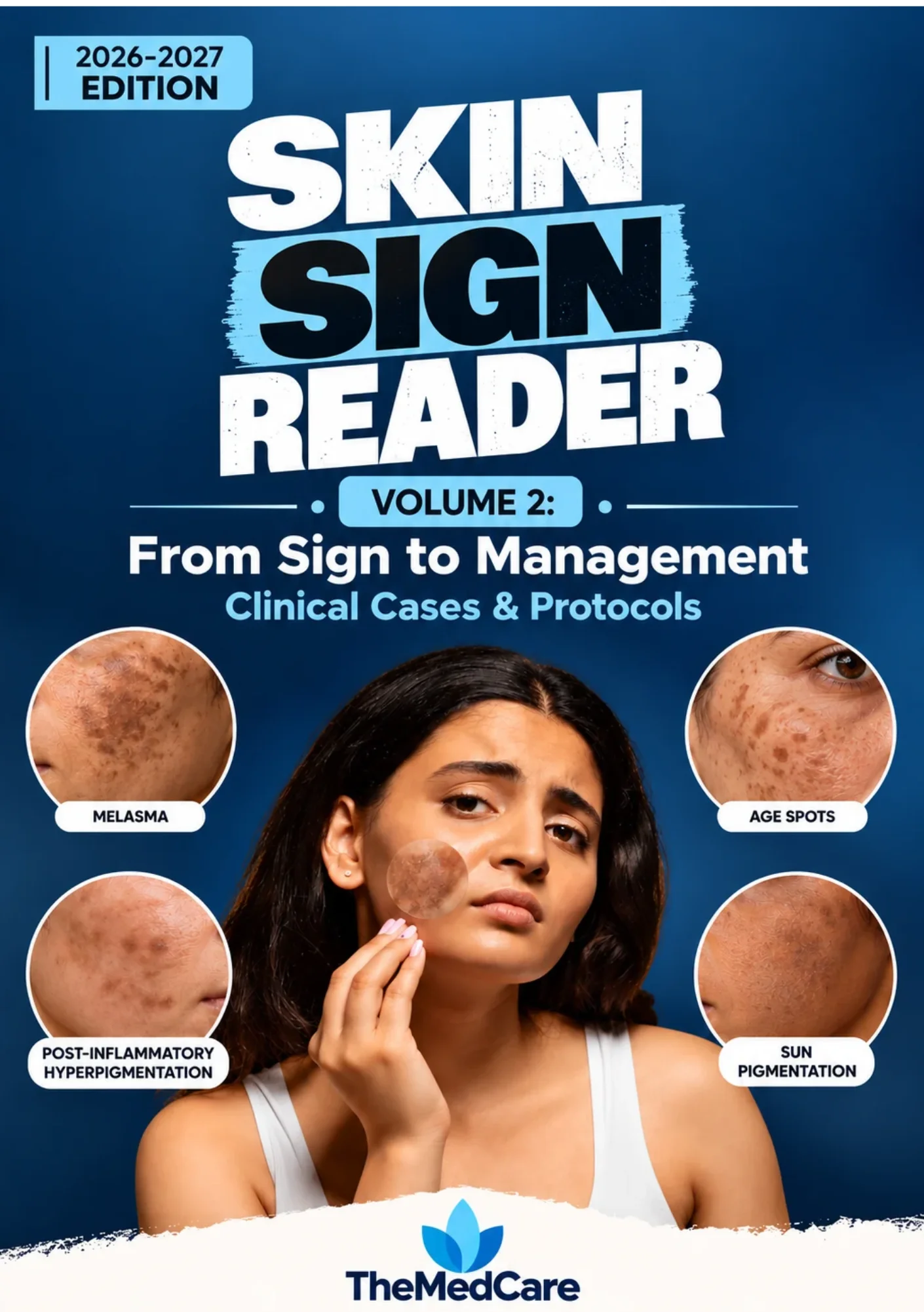
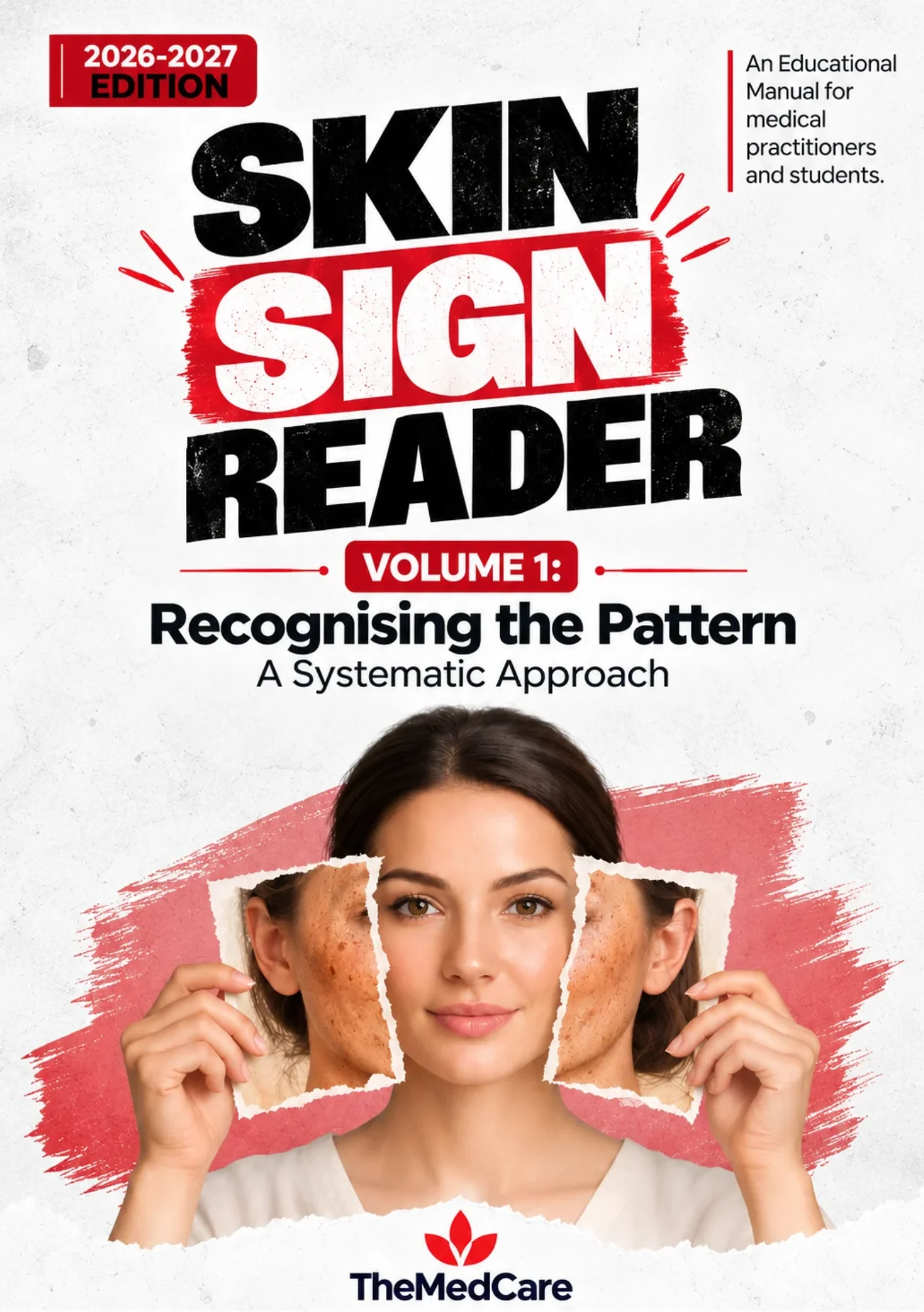
Skin patients in India rarely look like the textbook.
By the time they reach you, the rash has been treated by the chemist, the lighting is poor, and you have three minutes. These are the moments this set was written for.
Doctor, chemist ne cream di thi, pehle theek hua phir wapas aa gaya.
A steroid combination cream wipes out the scaly edge you were looking for. The book shows how a steroid-modified ring looks and what to ask.
Vol 1 · Ring-shaped patterns, p39–41Redness dikh hi nahi rahi.
On brown skin, erythema shows as violet, grey or darker brown. Less visible redness does not mean less inflammation, so you learn to check warmth and swelling by touch.
Vol 1 · Colour on Indian skin, p13Ring hai. Fungal hai ya leprosy?
Miss reduced sensation on a patch and you miss a referral. Every ring page tells you what to look for, what to ask, and when to refer.
Vol 1 · Leprosy, p91Kitni cream, kitne din?
Potency, vehicle, fingertip units, duration and step-down. Most treatment failures start with these five, and Volume 2 sets them out in one toolkit.
Vol 2 · Management toolkit, p5Teen mahine se wahi tinea.
Recalcitrant dermatophytosis is worked through in order: confirm the diagnosis, check steroid use, check the course, check the household.
Vol 2 · Fungal & infective, p16Isse refer karna hai ya aaj hi bhejna hai?
Ten high-priority red flags, each marked as today or this week, with the page to turn to.
Vol 1 · Red flags, p87–94See the sign. Name the pattern. Know the next step.
Every pattern page in Volume 1 ends with the same three boxes: Look for, Ask, and Refer if. Volume 2 tests every paragraph against one question.
“Does this change what the practitioner will do next?” If not, it is not in the book.From what you see to the right page in about a minute.
Start with the sign
Whatever your eye caught first: a scaly patch, a ring, a blister, a white patch.
Open a finder
Page 5 sorts by body site, page 6 by appearance. Both lead to the same pattern page.
Read the pattern page
A differential table where each name comes with the clue that sets it apart.
Stop at three boxes
Look for, Ask, Refer if. Then record it with the 8-point description template.

A real page close: the ring-shaped patch
This is how Volume 1 condenses one pattern for daily use. Taken word for word from page 41.
Look for
- Edge: scaly and active, or smooth and beaded
- Centre: clear or filled
- Scale present or completely absent
- Sensation reduced on the patch
- Is the patch dry
Ask
- “Is it itchy or not?”
- “For how many months? Has it grown or stayed the same?”
- “Which cream was applied?”
Refer if
- Reduced or absent sensation on a patch
- Any thickened or tender nerve
- Weakness or tingling in hands or feet
- Ring enlarging but KOH repeatedly negative
Recognising the Pattern
A systematic approach to reading skin. No drugs or doses here, only how to look, examine and recognise, so the diagnosis comes before the cream.
- Part 1p7–20
The language of skin
Primary and secondary lesions, colour, shape, arrangement, distribution, border and the 8-point description template.
- Part 2p21–30
The 3-minute examination
Lighting, sequence, commonly missed sites, palpation, bedside tests like diascopy, Auspitz, Nikolsky and dermographism, Wood's lamp, KOH, nails, hair, mucosa.
- Part 3p31–54
Pattern recognition
Scaly, itch without rash, ring-shaped, blisters, white, dark, red and pustular patterns, each closing with three boxes.
- Part 4p55–72
Site-wise reading
Scalp, face, flexures, hands and feet, nails, genital region, legs, trunk and infant skin.
- Part 5p73–86
Skin as a systemic window
Diabetes, thyroid, liver, kidney, nutrition, autoimmune disease, malignancy, drug reactions, HIV and pregnancy.
- Part 6p87–94
Red flags
SJS/TEN, erythroderma, necrotising infection, leprosy, pigmented lesions, purpura, and refer today versus this week.
From Sign to Management
Clinical cases and protocols that start where recognition ends. Classifications and durations carry numbered references to NICE, AAD, CDC, MHRA, BAD and Indian literature, framed within your registered scope of practice.
- Part 1p5
The management toolkit
Vehicle, potency, fingertip units, duration, withdrawal, combination creams and a master grid.
- Part 2p16
Fungal and infective
Dermatophytosis, recalcitrant tinea, candida, bacterial infection, scabies and viral lesions.
- Part 3p24
Eczema and dermatitis
Atopic, infected eczema, contact, hand, seborrhoeic and stasis dermatitis, plus an emollient protocol.
- Part 4p30
Papulosquamous
Psoriasis, lichen planus, pityriasis rosea, keratoderma and xerosis.
- Part 5p33
Pigment, hair and nail
Melasma, post-inflammatory hyperpigmentation, vitiligo, alopecia and onychomycosis.
- Part 6p38
Acne and facial
Acne framework, marks and scars, rosacea and perioral dermatitis.
- Casesp40, p51
Case library · 26 cases
Impetigo, infected eczema, acne in pregnancy, nail disease, zoster, topical steroid withdrawal and more, each with what to tell the patient.
- Part 7p63
Special groups
Children, pregnancy, breastfeeding, older adults, diabetes and occupational skin disease.
- Part 8p65
Counselling, follow-up and failure
Response ranges, follow-up, audit and referral.
Volume 1 teaches you to see
- Lesion morphology
- Colour, border, surface
- Distribution patterns
- Examination technique
- Pattern recognition
Volume 2 tells you what to do
- Which class of treatment, and why
- Potency, vehicle, quantity
- How long, what to monitor
- Why treatment fails
- When to refer, what to tell the patient
Ten signs you must not send home.
The red-flag chart from Volume 1. Each one comes with its own page on what it looks like and where to send the patient.
In every emergency: vitals, check mucosa, drug list, refer. The local emergency protocol is final.
Real pages. Clinical photos on Indian skin.
Spin the ring or tap any page to read it full size.
Drag to spin · tap a page to open it
What doctors and medical learners say
Early feedback on Skin Sign Reader from people who work with skin every day.

“What I find useful about Skin Sign Reader is its focus on recognising visible skin changes and understanding their clinical relevance. The structured approach looks helpful for revising dermatology concepts and developing a more systematic way of observing skin conditions.”

“The idea of having skin science concepts presented in a structured format is appealing. It looks suitable for reviewing skin anatomy, common dermatological conditions and important clinical terminology without relying on scattered notes.”

“A structured guide to skin science can make revision more manageable. I like the emphasis on understanding skin conditions and their clinical presentation rather than simply memorising medical terms.”

“The book looks like a helpful learning companion for becoming more familiar with skin-related medical terminology and common dermatological conditions. The organised approach makes it appealing for healthcare professionals who want to strengthen their foundational knowledge.”

“As a medical learner, I find the concept of a dedicated skin science reference appealing. It looks useful for revising important dermatology concepts and building a clearer understanding of skin structure, conditions and clinical terminology.”
Two books that sit on your OPD desk.
Volume 1 · 96 pages
Lesion language, the 3-minute exam, 8 pattern families, site-wise reading and systemic signs.
Volume 2 · 68 pages
Management toolkit, 6 condition parts, special groups and follow-up.
26 worked cases
Each with the thinking, the plan, and the exact words to tell the patient.
Two finders
Find the page by body site or by appearance, in about a minute.
Red-flag referral chart
Ten signs, each marked today or this week.
Template + glossary
8-point description template and a Hindi–English glossary for patient talk.
Soft copy
- Both volumes, 164 pages
- Instant access after payment
- Read on phone, tablet or laptop
- Full-colour clinical photos
- Printed books
Hard copy + free soft copy
- Both printed volumes, A5, full colour
- Soft copy free, so you can start reading today
- Free delivery across India
- Flip to the finder pages between patients
- Write your own notes in the margins
Secure checkout · UPI, cards and net banking
Is this set for you?
Yes, if you are
- An MBBS, BAMS or BHMS student or intern who wants dermatology to make sense
- A GP or family physician who sees skin cases every day
- A rural or PHC medical officer working without a dermatoscope
- Nursing staff or a healthcare learner building skin vocabulary
- Revising dermatology concepts for exams
Not for you if
- You are a patient looking to treat your own skin. This is a practitioner's educational reference; please see a doctor.
- You want a large reference atlas for dermatology residency
- You want fixed prescriptions to copy. Volume 2 gives referenced ranges and what they depend on.
Questions
Who is Skin Sign Reader written for?
Medical students and interns (MBBS, BAMS, BHMS), general practitioners, family physicians, rural medical officers and nursing staff. It is written for clinics where there is no dermatoscope, biopsy is far away, lighting is poor, and the patient has already applied a cream from the chemist.
What is the difference between the two volumes?
Volume 1 is about seeing: lesion language, examination, pattern recognition, site-wise reading, systemic signs and red flags. It has no drugs or doses. Volume 2 is about doing: the management toolkit, condition-wise approaches, 26 worked cases, special groups and follow-up.
Is Volume 2 a prescribing guide?
No. It is an educational reference. Classifications and durations carry numbered references to sources such as NICE, AAD, CDC, MHRA and Indian literature, and they are given as ranges with what they depend on. Every prescribing decision stays with a qualified practitioner within their registered scope of practice.
Does it include clinical photos?
Yes. Both volumes include clinical photographs on Indian skin alongside original schematic diagrams. You can see real pages in the Look inside section above.
What language is it in?
Simple, clear English, with a Hindi–English glossary at the back of Volume 1 to help you explain findings to patients.
How do I receive the soft copy?
You get access right after payment and can read it on your phone, tablet or laptop. If you order the hard copy, the soft copy comes free so you can start before the printed books arrive.
How is the hard copy delivered?
The printed set is shipped to your address anywhere in India with tracking details sent to you after dispatch.
Your next skin patient is already in the queue.
Both volumes, 164 pages, 26 cases. Read the soft copy tonight, keep the printed set on your desk.